Showing posts sorted by relevance for query timers. Sort by date Show all posts

Thursday, July 7, 2011

Timing Is Everything

One of the most common problems that we find on landscape lighting systems is the use of cut-rate mechanical timers to control the on/off operation of the lighting system. Even though we see this issue everyday, there are several good reasons why a cheap timer is a bad idea on a good lighting system.
First – and most critical – is that these timers are usually designed to be used indoors only. Moisture, insects, dirt and other elements of outdoor use cause these timers to malfunction regularly. Another reason to avoid sub-standard timers is their inability to handle power outages. These timers must have electricity at all times or they will lose time and programming. You’ll notice the system not turning on until well past dark, or staying on during the day when this happens. Also, a manual timer will not automatically adjust for seasonal changes in light and darkness. It’s not fun having to constantly adjust the timer to keep up with the daily time of sunset or Daylight Saving Time.
Breezeway
Controlling a high quality lighting system should be almost effortless for the property owner. There are a number of ways to accomplish this, and we use a lot of them - but we never use mechanical timers. One of our favorites to use is an astronomical timer. This timer is set to operate according to your actual location, using your longitude and latitude settings. This allows the system to operate only from dusk to a specified time or dawn, and automatically adjusts each day. This is far better than a photo cell since it’s not affected by shade, clouds or debris on the lens. The timing system works completely automatically, even for Daylight Saving Time, so there’s no need to make any manual adjustments. Additionally, the astronomical timer has a battery back-up eliminating failure even if the power goes out (the timer, not the lighting). Another control device, universal powerline bus/radio frequency, allows us to operate the landscape lighting and the home’s exterior lighting together as a unified system. The program will permit us to dim the home’s exterior lighting to the same levels as the landscape lighting, creating a lovely, uniform lighting scheme across the project, operating from dusk to any selected off time. This UPB/RF system is programmed and then managed from almost anywhere in the world using an IPhone, IPad or IPod Touch as a remote controller.
The main point here is that we want the operation of the lighting system to be as effective and efficient as possible. We don’t want lights to be on when not needed, and we don’t want anyone to be forced to constantly deal with the inconvenience of making adjustments all the time. These professional control devices may cost a little more than a big-box mechanical timer, but will easily pay for themselves by reducing energy waste turning the lighting system on unnecessarily. The effectiveness of a quality timer also ensures that your lighting system will work when you want it to without wasting your time with the inconvenience of manual adjustments.
Like they say, timing is everything and we like to help everyone save time and money.

Saturday, September 28, 2013

Shorter Days and Longer Nights. Welcome to Fall

Have you noticed that the days are getting shorter?

Every September we celebrate the official beginning of autumn, and we begin to lose about a minute of daylight every day. Although that doesn’t seem like very much, over the course of a month, it adds up to a half hour of lost daytime! Shortly after the equinox, (about 6 weeks now, being in November) in most of the country, we’ll also be setting our clocks back an hour for the end of daylight savings time and lose a whole hour in one day!

Fall back

This brings a few things to my mind. First, here in central Texas our summer days are very hot and it’s just flat uncomfortable to be outside until very late at night -- and even then it’s not easy in the mid-summer months of July and August. So the cooler fall and winter evenings are much nicer to get outside and enjoy. And it won’t be long before it’s dark when we get home from work -- which means there may be challenges to moving around safely on your property. Finally, there are always some issues with timers that come up whenever there is a time change.

I actually like spending time outside in the fall and winter evenings, and it sure is wonderful when it’s not so dark and scary looking out across my yard. A little bit of soft lighting makes this time outside much more comfortable for everyone, even a big tough guy like me. There are creepy and menacing things skulking around out there in the darkness. Even if it’s just a skunk - I want to see it, so I need some lighting!

steps 2

Also important is that we want to be able to navigate safely when the sun goes down. I notice that as I continue to age, my eyesight is not as good at night as it used to be; it takes longer for my eyes to adjust to the darkness. Arriving home after dark, or entertaining in the evening gives me pause to insure that my walkways are well lit reducing the chances for a fall and causing serious injury for myself or my guests.

Finally, there is the whole timer issue. It seems that many lighting companies will still install the old mechanical timers that must be constantly reset for changes in time -- which actually happens every single day. Starting on the first day of winter, the days begin to get longer (in the northern hemisphere) bit by bit, and the nights get shorter. Then the first day of summer is the longest day of the year, and each day after gets just a little shorter. So these mechanical timers will always need to be adjusted, or it results in lighting systems operating during daylight hours unnecessarily, or failing to come on until after dark. Both instances can be expensive, though in very different ways. We have never installed these type timers in our systems. Way back when we first started out, we used a digital timer with a battery back-up, along with a photo cell, to insure the lighting would not operate until it was dark enough; therefore, we only had to adjust the timer a couple of times a year. Now we have a truly great advancement: astronomical timers! WE LOVE THESE THINGS! We can program in your zip code (or longitude and latitude) and the timer automatically adjusts every single day. It even adjusts for daylight savings time! Now we simply change the battery once a year when we’re already on the property for the semi-annual spring or fall maintenance check, and the system is always working properly when needed.

astro timer

We hope you will enjoy these more pleasant temperatures coming soon in the fall and winter. Please let us know how we can help you feel a little safer and more comfortable during those cooler but darker hours.

Friday, June 28, 2013

But THAT Guy Will Do It For….

After running into some atrocious lighting systems in the past couple of weeks, I felt like I just had to address the whole issue of pricing because I think a lot of people do buy simply on price without comparing “apples to apples” when shopping for an outdoor lighting company.

Why are some systems very cheap while others are very expensive? There are a lot of variables that go into pricing an outdoor lighting system. Most folks only think about fixtures and labor, and don’t begin to think about the big picture and everything else that goes into a system’s price.

Let’s begin with the design. A good design can make a major difference in the impression or atmosphere your lighting system will create. Ask yourself (and your contractor) these questions to determine the potential skill level:
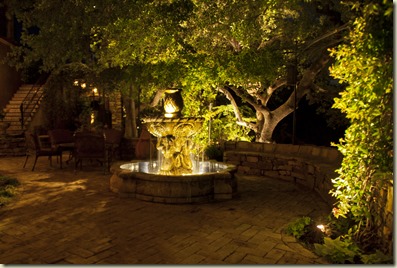
Fountain 1

· Did the person designing the system have any formal training from lighting design experts (which can be costly), or did they take a half day seminar on lighting sales from a supply house for free?

· Do they keep up with current trends and the latest knowledge of lighting technology, or just keep on doing the same old thing?

· Do they attend yearly education classes to learn and hone their craft?

· Do they test several products a year to find out first-hand what effects can be achieved?

All of these help determine pricing. Think about your surgeon – wouldn’t you likely check his/her credentials and education before you invested in his expertise? Would you expect him to keep up with advances in procedures, techniques and technology? Wouldn’t you hope that he participates in some sort of ongoing education to hone his skills? Of course, landscape lighting isn’t brain surgery, but a true professional cares passionately about the quality of his work no matter what where his field of study lies.

Now let’s talk about materials. There are a wide range of lighting products on the market today. Most people are only familiar with the stuff you can find at the local home improvement store. Although this may be convenient for the do-it-yourself guy, these actually represent the bottom of the product quality spectrum. On the opposite end of that scale is what we call the “spec” grade products. Spec grade materials are developed after years of research using the highest quality minds and materials available; which can lead to a price tag of several hundred dollars per fixture. They are designed to perform more precisely and last longer than their cheap counterparts. The middle ground is vast and quite variable. There are hundreds of outdoor lighting manufacturers out there with hundreds of different prices for hundreds of fixtures. Let’s compare this to designer fashions: You have the high-end products created from the designs of artistic minds using expensive, rare and magnificent fabric on one end, created to be durable, well-fitted and flattering. On the other end of the scale you have the “it only costs a dollar” dress. Like fashion, there are a lot of cheap knock-offs - spun brass, lightweight copper and plastic fixtures trying to imitate the quality leaders that are more expensive but made of heavier brass, copper and bronze that also have better warranties. So, the contractor may pay anywhere from $20 per fixture for something from your big box retail home improvement store, to several hundred dollars per fixture for the product that they recommend because it will perform better for a longer period of time in the environment where you live. When you compare pricing, be sure that you know what the quality differences are among the products your contractors are planning to use. What value do you place on performance and longevity?

Additionally, there are necessary installation tools, wire (made of copper), lamps (light bulbs) or light emitting diodes (LEDs), wire connectors, transformers, timers, batteries for the timers, automation equipment, screws and more little things that are necessary to a quality installation. Just like the fixture differences, there are huge price and quality differences in the other materials used in putting an outdoor lighting system together. The products used make a big difference in pricing.

And of course someone will be spending time to install the well-designed system. Can they communicate well with the client? Do they look presentable and behave professionally while in your neighborhood and on your property? Do they know every aspect of what they are doing and can they answer your questions? Are they certified by a nationally recognized association for their profession? Maybe they normally just dig holes for plants and installing lighting is a sideline; or maybe they are handyman types with no actual lighting experience at all. Do these installers have benefits with their company, or do they make minimum wage with nothing extra? Do they participate in ongoing technical training just like the designer? A quality workforce is not cheap - and this, too, must be considered when setting up pricing for your lighting system.

What about insurance? Does the contractor have liability insurance? How much insurance? If your home is worth $3,000,000.00, does the contractor have enough insurance to cover it if something went terribly wrong? Are all or any of their vehicles covered? In Texas, workers compensation insurance is not required by law but maybe your state does require it. Do you realize how costly insurance is?

Does the lighting company work out of their home, or do they have some other location where they run their business, keep their inventory and park their vehicles? What kind of expenses does that location cost with its utilities, insurance, rent/mortgage, and maintenance? The cost of other overhead could also include health insurance, cell phone services, costs of electronics, fuel, vehicle maintenance, advertising, and other things specific to that operation.

Finally – and very importantly - there is the service after the sale/installation. Will you hire the lighting company that doesn’t return after dark to make sure all the lighting is adjusted properly to the right look? What sort of warranty of service can you expect from your contractor after the installation? If they promised you service, can you count on them to provide service when you need it? The differences in product warranties and services can be as vast and varied as the many product choices. While some companies may offer 6 months of service after the sale, others may cover the system from bumper to bumper (so to speak) for three years. It’s probably safe to say that the company that shows up for three years just to clean the fixtures for optimal lighting (at no extra charge) probably costs a little more than the company that won’t even stick around until it gets dark. How much value is there in doing business with a company of integrity?

So a lighting system is far more than a list of materials and a few hours labor. It’s good to research and shop. But be sure to compare components equally. Apples to apples – not dog food to prime rib! It has been my experience that we usually get what we pay for, and it’s important to know what that is before you write the check. The educated buyer will get the right value for their money.

“The bitterness of poor quality remains long after low pricing is forgotten!”
~ Leon M. Cautillo

“Quality improvement is the primary source of cost reduction. Poor quality has a huge, documentable cost.”
~Tom Peters

Wednesday, August 7, 2013

How Much Does a Landscape Lighting System Cost?

This is the ultimate question in our industry! Although I’ve covered this in other ways on this blog, I don’t think I’ve ever come right out and talked about actual numbers. I’ll try to do that here.

WHY? The first thing that will help to determine the cost of your outdoor lighting system is the answer to the question, “Why do you want lighting?” This answer will help to establish the depth of the design of the lighting plan. For example: If you only want to light the walkway from the driveway to the front door because it’s dark, or you just want a few lights for security reasons, then the cost is not going to be as much as someone who wants much more. An individual who has an extensive landscape, a large beautiful home, an outdoor living/entertaining area where they love to have guests, and knows how outdoor lighting can enhance the ambience of all these areas, then that outdoor lighting system is going to cost a LOT more.

WHAT? Next consideration is the quality of the products you may choose. Many folks see solar lights and DIY lighting kits available at the local home improvement store. These represent the very low end of the outdoor lighting goods on the market today. You can buy a small solar or LED do-it-yourself kit at one of these stores for about $100. The solar lights won’t last very long at all and will probably be in the trash quickly, while the LED do-it- yourself kit might last 6 months or a year. On the other hand, a professional grade LED outdoor lighting fixture - just one fixture - could cost anywhere from $125 to $450 -- or more depending on the type of fixture (its function) and the construction materials. Brass, copper, aluminum and nickel are some options out there contributing to the variance in cost. But these fixtures will also last anywhere from 5 years to a lifetime. Do you want high voltage or low voltage lighting? High voltage lighting products (which operate at 120 volts or more) can cost quite a bit more than low voltage lighting products.

Escondido 3

HOW? Now, how about installation? If you install the home improvement kit yourself, the cost is whatever your time is worth to you. High voltage lighting must be installed by a licensed electrician, and must be installed according to the National Electrical Code and any local codes. Permits need to be issued and inspections made along the way as the system is being installed. Wire must be buried to at least 18” deep which means trenches have to be dug in your yard. All this add up to a lot of money for the contractor. Low voltage lighting that operates at less than 24 volts, in most parts of the United States, do not require permits, inspections, trenching or licensing. This can mean cost savings in installation, even when using a professional. It must, however, also be installed according to the National Electrical Code.

DESIGN? Have you considered the actual design or plan for your lighting? Once again, if you are designing the system yourself, the cost is free, as long as you know enough about the products you use and the way light operates. Some green industry companies offer a “free” design or “free” demo, but the cost of the time taken here is actually hidden - rolled into the price of the finished project because everyone must recoup the costs for their time and materials used for these services. (See our blog post on this topic here.) Some companies, like ours, will charge a design fee because we are actually a lighting design company. Think about it this way: You can’t get an architect to design your home for free because designing homes is what he does to earn a living. And naturally the builder can’t determine the cost of building that home without a full architectural plan from which they can calculate the cost of the project. As I have mentioned before in previous blogs, the expense of education required to learn the skill of lighting design is quite high compared to an afternoon at the irrigation supply house learning how to “sell” outdoor lighting to increase profits. So a well-thought out design is necessary to assess the cost of the completed lighting system.

MG315457AZT

HOW MUCH? Last, but far from least, is profit. This is the down and dirty part of any business these days; but personally, I think it’s the part of business that makes our country (the United States of America) the envy of the world. Obviously, if you are doing the project yourself there are no profits to be determined. But there are contractors who really have no idea about the costs of doing business. They just say to themselves that they want to make a certain amount per hour and that’s it – so they may offer to do this work for you at a bargain price. (We have covered this more extensively in a previous blog here.) Company profits don’t come until all of those overhead expenses are deducted. Payroll is the single greatest expense for any employer; honest, reliable, well-trained technicians don’t come cheap – and no homeowner would be comfortable with an unscrupulous laborer with a questionable background walking around their home or poking around on their property. My point is that it costs a lot of money to conduct a reputable and profitable business which can stay around long enough to back up the work that they do. Also figured into the cost of doing business is warranty work. Our company provides three years of service with each new residential installation project. No matter how good the product or installation is, things go wrong. Lights go out, timers fail -- and we have to come back and take care of it at no additional charge to the client. These expenses still need to be calculated into each and every job in order to be cost-effective enough to keep the doors open. Those companies who suffer a lot of failures will eventually also fail themselves as they try to recover expenses by charging too much, or by simply letting go of the drowning albatross (the company). A company, who is mindful of good business practices, uses quality products, installs them well, and charges a fair price will do just fine.

There are several other things that go into the pricing of an outdoor lighting system, but these are the obvious biggies that must be considered. So here is the answer to the question: Our company, NightScenes Landscape Lighting Professionals, has completed a very wide range of projects since we began almost a decade ago in this industry. Prices have gone up over the years, both due to normal increases in manufacturing and labor, as well as the giant leap from incandescent, halogen and high intensity discharge (HID like mercury vapor and metal halide) to LED. Over 90% of our installation projects come to us by client and industry referrals, and are usually large estate properties. We have installed small projects for about $2000, and projects upwards of $100,000. Our average residential project is in the neighborhood of $14,000 for approximately 40 fixtures; and we don’t do very many commercial projects.  The commercial projects are those that can get into the $100K range.

Learning and honing a craft by attending schools around the country; gaining and maintaining industry certifications; researching and using high quality products; hiring and training employees of integrity and treating them well; paying for and controlling overhead expenses; and making a fair profit to continually improve our business all go into the pricing of a superior outdoor lighting system. Those who don’t cover everything outlined here will, of course, be able to charge less - while those who share our business profile may charge more. Potential clients who have very limited budgets may have to trade some value features for price; while others demand the highest available quality and will gladly pay what they feel is a reasonable price for excellence in product and company reliability.

Hopefully now you have a realistic idea of what you should expect to pay for a low voltage landscape lighting system.  If you do need more information, please don’t hesitate to drop us a note at info@night-scenes.com .